
Documentation map
Use this page to navigate the Graftcode documentation ecosystem.
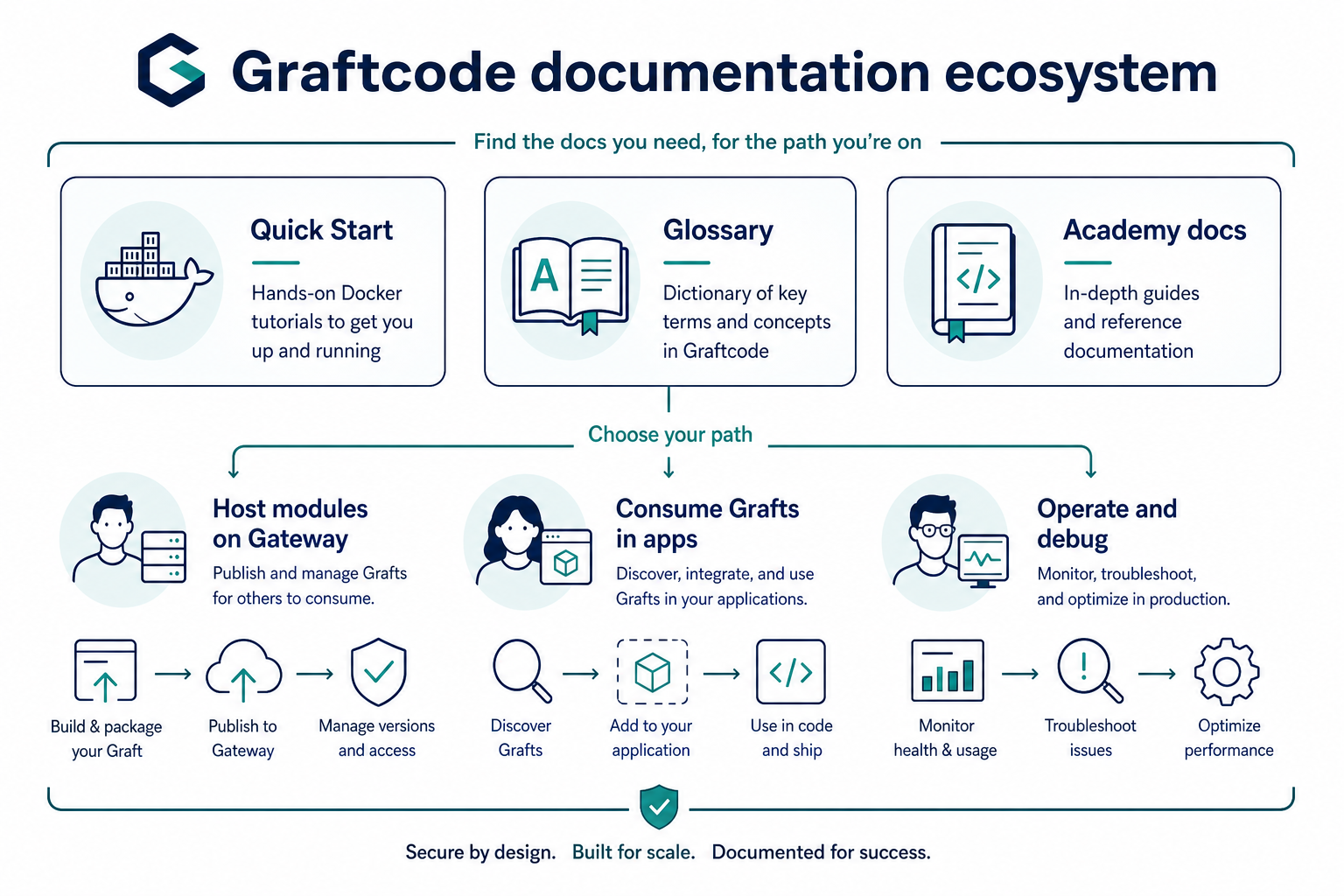
Three surfaces
| Surface | Where | Best for |
|---|---|---|
| Quick Start (hands-on) | Quick Start | Step-by-step Docker tutorials; complete a working integration in minutes |
| Glossary | Glossary | Look up terms (Graft, UGM, Hypertube, Virtual Feed, …) |
| Documentation (this site) | Concepts, how-to guides, reference | Configure GG, consume Grafts, troubleshoot, understand architecture |
For terms not yet on the Glossary (Project Key, noVersioning, …), see Glossary supplement.
Diagrams and screenshots: Visual assets guide — full index with links to every illustration.
Choose your path
I host modules on Graftcode Gateway (GG)
- Learn by doing: Quick Start tutorial #2 – Expose a Backend
- Install GG: Install and download
- Configure: CLI reference, Ports and protocols
- Project setup: Project Key and Registry URL
- Advanced: Versioning, Filter exposed types, MCP
I consume Grafts in my application
- Learn by doing: Quick Start tutorial #1 – Connect Frontend to Backend or #3 – Connect Microservices
- Install: Install a Graft
- Configure: GraftConfig reference, In-memory vs remote cookbook
- Edge clients: Edge client authentication
- Multiple services: Configure multiple Grafts
I operate or debug Graftcode
- Debug: Debugging runbook
- Observability: Observability setup
- Reference: Troubleshooting, Environment variables
- Scaling: Scaling, load balancers, and proxies
I want to understand why Graftcode works this way
- Introduction — product overview
- Core concepts — Graft, Gateway, Hypertube
- How Graftcode works under the hood — IIP, UGM, execution flow
Quick Start tutorial index
See also: Quick Start tutorials · Visual assets guide