
Stateless vs stateful execution
When to use this
You need to choose between independent request-style calls (stateless) and object lifetimes, callbacks, and events (stateful) — especially for edge clients and load-balanced services.
Prerequisites
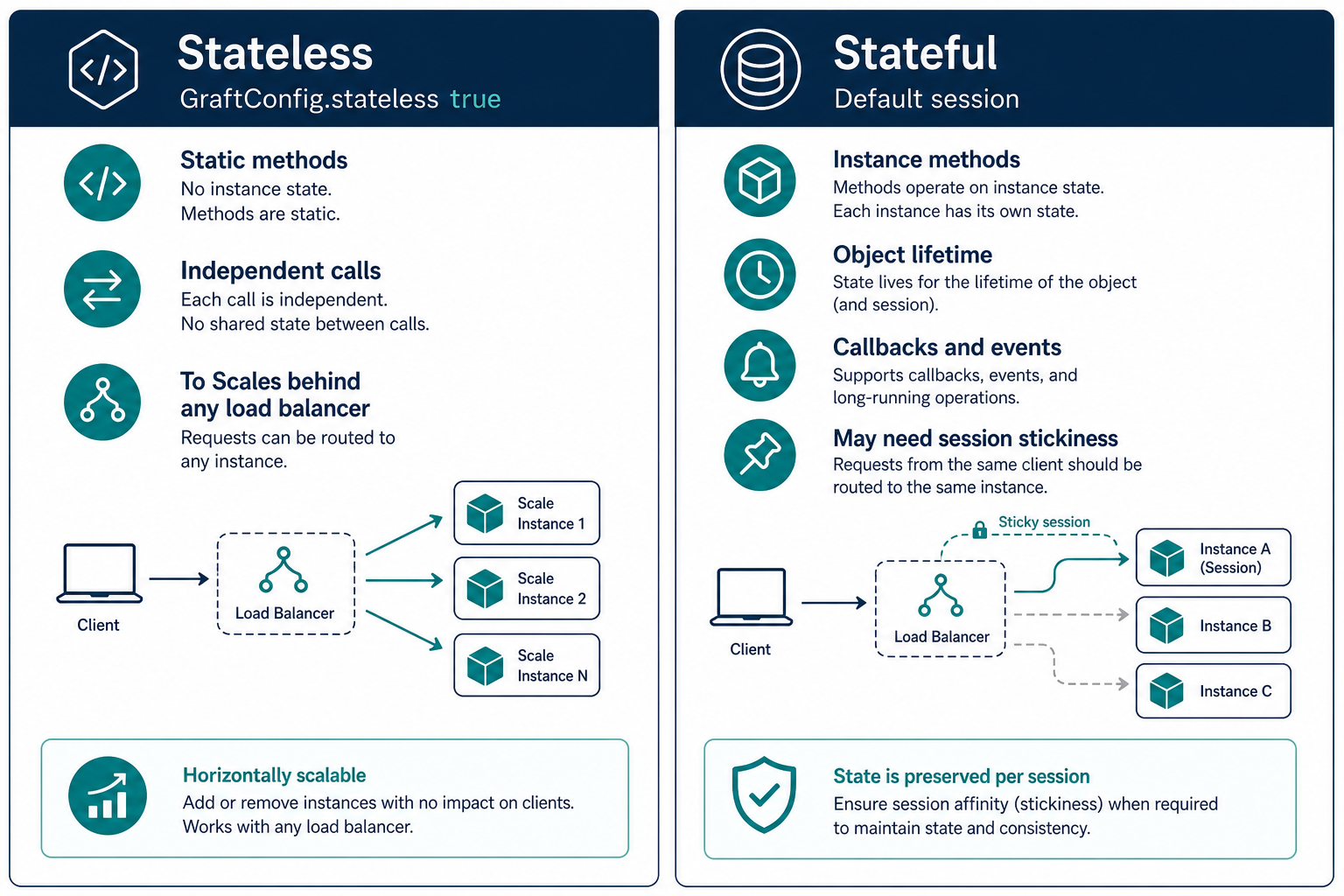
Stateless execution
Characteristics:
- Each call is independent
- No server-side object retained between calls
- Maps to static methods and simple DTOs
- Scales horizontally without session stickiness
Interface pattern:
public static class OrderQueries
{
    public static OrderDto GetOrder(string orderId) => /* ... */;
}
GraftConfig:
GraftConfig.stateless = true;
GraftConfig.stateless = true;
Best for: edge clients (tutorial #1), MCP tools, read-heavy APIs.
Stateful execution
Characteristics:
- Object instances live on the receiver
- Properties and methods on returned objects may trigger additional round-trips
- Callbacks, events, and delegates work over full-duplex Hypertube sessions
- Load balancers may need session stickiness
Interface pattern:
public class ShoppingCart
{
    public void AddItem(string sku) => /* ... */;
    public decimal GetTotal() => /* ... */;
}
const cart = new ShoppingCart();
await cart.addItem("SKU-1");
const total = await cart.getTotal();
GraftConfig: default stateless = false.
Best for: rich domain models, interactive workflows, service-to-service with long-lived objects (tutorial #3).
Alpha note: DTOs and statefulness
In Alpha, complex object parameters/returns can make calls effectively stateful (session stickiness required). Beta will improve stateless DTO passing. See Alpha limitations.
Comparison
| Aspect | Stateless | Stateful |
|---|---|---|
| Scaling | Easy horizontal scale | Sticky sessions or single instance |
| Edge / browser | Recommended | Possible but heavier |
| MCP | Required pattern | Not projected to MCP |
GraftConfig.stateless | true | false (default) |
| Interface style | Static methods | Instance classes |
Verify it works
- Stateless: parallel calls from many clients without shared state bugs
- Stateful: same object instance behaves consistently across method calls on one session
See also
Practiced in Quick Start tutorials #1 and #3