
Invocation lifecycle
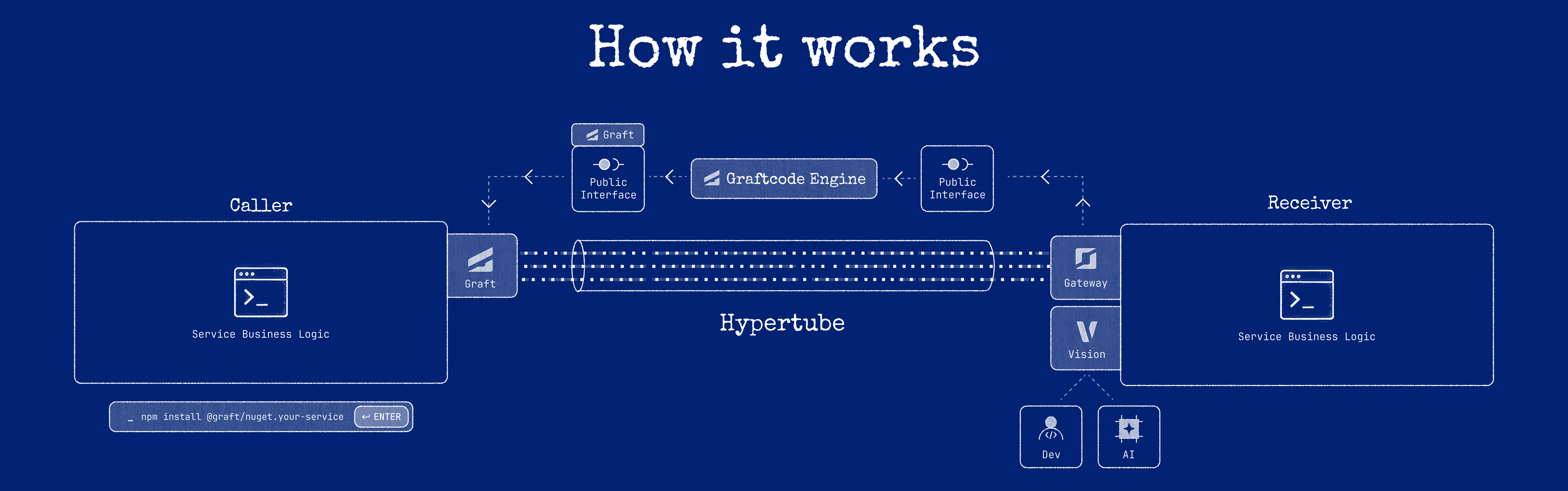
- Application code calls a generated member. Static and instance members use different generated handlers.
- The generated
GraftConfiginitializes once. It loads known environment and file sources, registers the generated default, and initializes a named runtime context. - Configuration resolution selects connection data. The winning source determines in-memory, WebSocket, HTTP/2, TCP, or plugin behavior.
- Generated code builds an operation. Instance operations carry the generated instance context; static operations target the type directly.
- Hypertube represents the call for transfer.
- The selected execution mode carries it. In-memory execution runs the Receiver in the same process; network modes send the call over the configured transport.
- The Receiver handles the call.
- The result is returned and converted back to the Caller's types.
Failure points
Failures can occur before execution (missing package or invalid configuration), during connection/transport, during dispatch, in user implementation code, or while mapping a response. Remote calls therefore require normal distributed-systems handling even though the call site resembles ordinary code.
Async, cancellation, and timeouts
Remote graft calls look like local methods, but async behavior splits into two layers. Confusing them is a common source of outdated assumptions (for example that a .NET Receiver must expose only synchronous methods, or that only Node.js Callers get an async API).
Two layers
| Layer | What it means |
|---|---|
| Receiver (callee) | Native async (Task, Promise, async def, …) is completed on the Receiver before the result is serialized. Live Task/Promise handles are not transferred over the graft wire. |
| Caller (generated Graft + Hypertube SDK) | Each invocation uses synchronous execute() / Execute() or parallel execute_async() / ExecuteAsync() on the Hypertube InvocationContext chain. Parallel async RPC does not require the Receiver method to be async. |
Hypertube does not expose a consumer model based on polling GetAsyncOperationResult (protocol command 44) for ordinary Graft usage. Treat each graft call as one request → one completed result (or error).
Also keep these distinct:
- Receiver internals can use async code freely behind a public method.
- Receiver public contract: native async return types (
Task/Task<T>,Promise,async def, …) are supported as completed results on the Receiver side. They are not live handles over the wire.CancellationTokenand similar cancellation parameters are not a portable public contract—keep them internal. - Generated Caller API: shape depends on the Caller runtime and UGM completion metadata (
METHOD_COMPLETION). You may seeTask/Promise/coroutines,ExecuteAsync/execute_async, or deferred wrappers for synchronous RPC across .NET, Node.js, Python, Ruby, PHP, and JVM. Follow the installed package and Vision, not a single-runtime example. - Parallel calls: the same Receiver method can be invoked with
execute_async()/ExecuteAsync()to run multiple RPCs concurrently; that is a Caller/Hypertube choice, not a change to the Receiver signature. - Cancellation and timeouts are a Caller/deployment concern. There is no built-in cross-runtime cancellation; apply timeouts, retries, and cancellation in Caller code and infrastructure. See Timeouts and retries.
Completion metadata (METHOD_COMPLETION)
During analysis, Graftcode can attach METHOD_COMPLETION to a method in the Unified Graft Model
(UGM) with two flags:
| Flag | Meaning |
|---|---|
IS_ASYNC_CALL | The source method is an async RPC shape (for example .NET async/await, or equivalent in other runtimes). The generated Caller uses async invocation (ExecuteAsync / execute_async, language async/await where emitted). |
HAS_DEFERRED_RETURN | The source return type is a deferred wrapper (Task<T>, Promise<T>, CompletableFuture, …). The generated Caller exposes a deferred return (for example Task<T> on .NET, Promise<T> in TypeScript) even when the Hypertube call uses synchronous execute(). |
Legacy UGM without METHOD_COMPLETION falls back to documented return types in COMMENT_RETURNS for
deferred-return detection (return type only, not parameters).
Three generated patterns (conceptual)
| Pattern | Typical Receiver | Hypertube call | Generated Caller (examples) |
|---|---|---|---|
| Sync | int Get() | execute() | Plain return type |
| Async RPC | async Task<int> Get() | execute_async() / ExecuteAsync() | async/await + deferred return where applicable |
| Deferred sync | Task<int> Get() without async | execute() | Task.Run (.NET), Thread (Ruby), CompletableFuture (JVM), coroutine wrapper (Python), … |
Always follow the exact method signatures and bodies in the installed package and Vision—they reflect these flags for your Receiver/Caller pair.
Async limits (unsupported or unsafe)
| Topic | Notes |
|---|---|
CancellationToken / cross-runtime cancellation | Not a portable public contract; use Caller-side timeouts. |
Task / Promise as RPC arguments | Do not pass live async handles as parameters. |
| Streaming live async handles | Results are flattened after Receiver completion. |
| Remote vs in-memory | Network calls still have latency and failure modes. |
Task / ValueTask / async on a .NET Receiver public method use completed-result semantics in UGM, separate from parsable framework types such as System.DateTime. See Known limitations.
What does not happen per call
The module is not re-analyzed and the Graft package is not regenerated during an ordinary invocation. Those belong to the package/build path.