
Hypertube runtime bridge
Hypertube is the runtime communication bridge between an installed Graft and Gateway. When your Caller invokes a generated method, Hypertube carries that call to the Receiver and brings the result back.
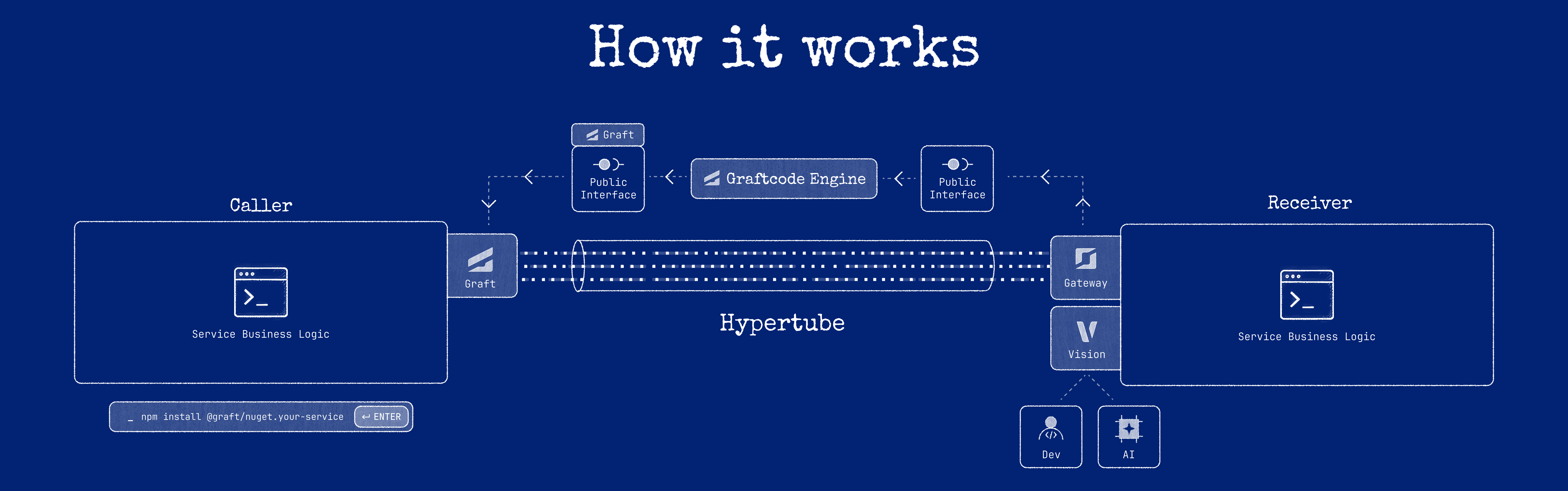
Where it sits
Caller → Graft → Hypertube → Gateway → Receiver
The generated Graft exposes methods that look like local calls. Hypertube is the layer beneath those methods that connects to Gateway, transfers the invocation, and returns the response to your code.
Execution modes
Hypertube uses the runtime host from resolved configuration to decide how a call executes:
- In-memory — the Receiver runs in the same process; no network hop.
- Network transports — WebSocket (default), and optionally TCP or HTTP/2, reach a Gateway over the network.
You select the mode by configuring the runtime host, not by changing business code. See Execution modes and Ports and protocols.
Connection setup
For a network host, Hypertube establishes a connection to Gateway on first use and reuses it for subsequent calls. Copy the exact host string (including scheme and path) from Vision; do not hand-construct routes.
What still applies (distributed-system properties)
A remote Graft call looks like a local method call, but it is a remote call. The following remain true and must be handled by your application and deployment:
- Latency — a network hop is not free.
- Serialization — arguments and results are represented and transferred; only supported types cross the boundary (see Type mapping).
- Partial failure — the connection or Receiver can fail independently of the Caller.
- Timeouts and retries — apply them in Caller code and infrastructure (see Timeouts and retries).
- Security — encrypt the transport and authenticate/authorize invocations (see Authentication and authorization).
How failures surface
When a call cannot complete — the Receiver is unavailable, the transport drops, or the Receiver raises an error — the failure surfaces to the Caller through the generated call (as an exception or error result, by runtime). Treat remote calls as fallible and handle errors explicitly. See Handle Receiver errors.
What Hypertube does not guarantee
- It does not make remote and in-memory calls behaviorally identical; network calls have latency and failure modes that in-memory calls do not.
- It does not provide cross-runtime cancellation, distributed transactions, or automatic idempotency.
- Transports do not all have identical failure or header semantics; choose the transport deliberately.
There is no published, versioned public wire specification you should depend on; treat the transfer format as an internal detail and rely on the generated Graft's method contract instead.
See Invocation lifecycle for the end-to-end sequence.