
REST and Graftcode coexistence
When to use this
You have production REST (or gRPC) APIs and want to add Graftcode incrementally — not replace everything at once.
Prerequisites
- Existing REST service
- Where Graftcode fits (concept)
Recommended approach
Graftcode adds a runtime integration layer alongside REST — it does not remove your HTTP endpoints.
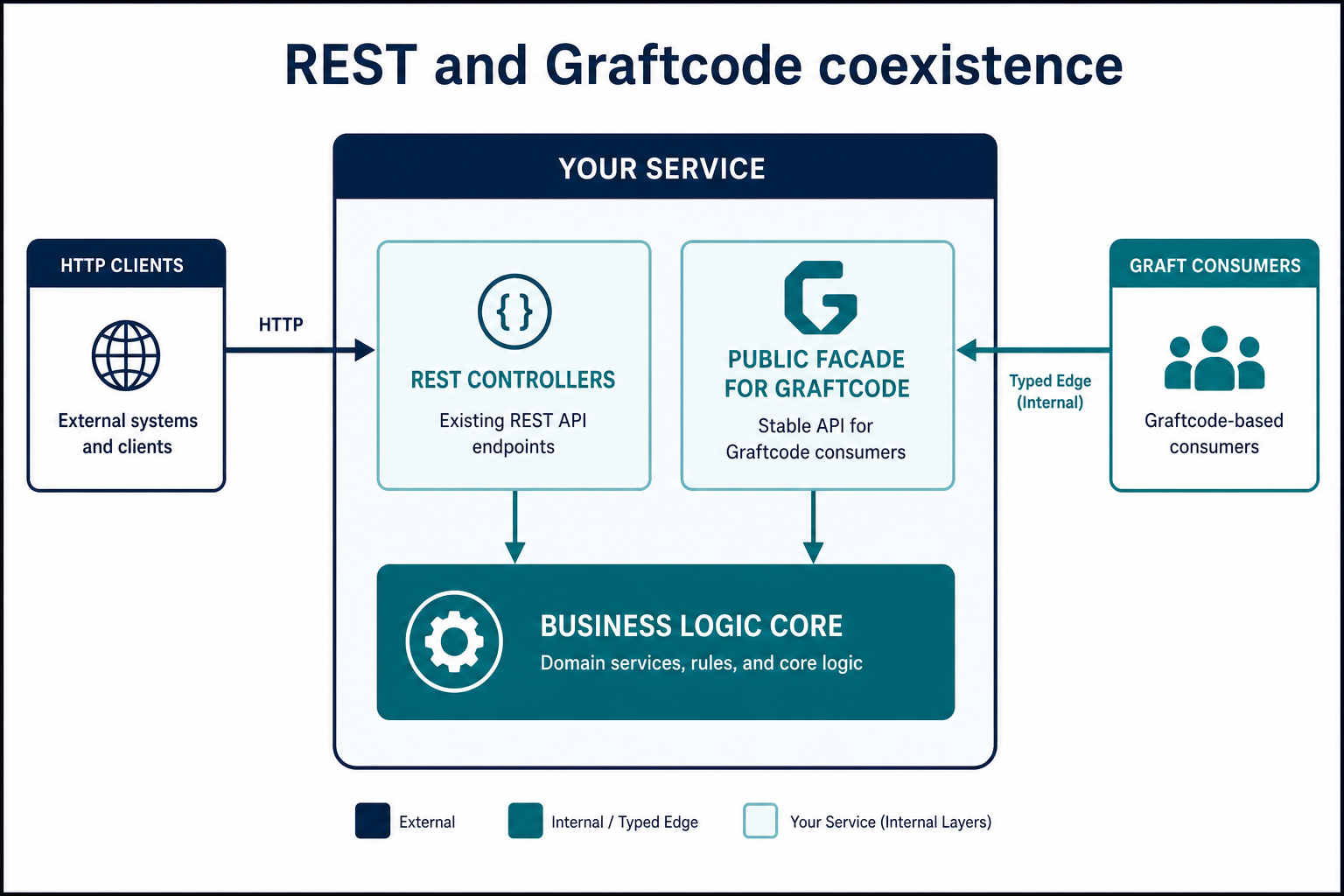
Steps
1. Extract a public facade for Graftcode
Expose public methods on a facade class; keep REST controllers calling the same core:
// Graftcode surface
public static class OrderFacade
{
    public static OrderDto GetOrder(string id) => OrderServiceCore.GetOrder(id);
}

// REST unchanged
[ApiController]
[Route("api/orders")]
public class OrdersController : ControllerBase
{
    [HttpGet("{id}")]
    public IActionResult Get(string id) => Ok(OrderServiceCore.GetOrder(id));
}
2. Host facade on GG
./gg ./MyService.dll --types MyApp.OrderFacade --port 8888 --httpPort 8889
3. Consume via Graft internally or from edge
Internal microservice:
import { OrderFacade } from "@graft/nuget-MyService";
const order = await OrderFacade.getOrder("42");
External clients can keep using REST while new apps adopt Grafts.
4. MCP alongside REST
GG exposes MCP automatically for configured facades — MCP expose tools. REST endpoints remain for non-AI clients.
Migration patterns
| Phase | REST | Graftcode |
|---|---|---|
| 1 | Primary external API | Internal service-to-service only |
| 2 | Stable public API | New edge apps use Grafts |
| 3 | Legacy clients on REST | New features on Graft surface first |
No big-bang rewrite required.
Verify it works
- REST regression tests pass
- Graft consumers call same business outcomes as REST endpoints
- Vision lists only facade types (not every controller)
Common mistakes
| Mistake | Fix |
|---|---|
| Exposing all controllers to Graftcode | Use --types facade only |
| Duplicating business logic | Facade delegates to shared core |
| Assuming REST must be removed | Coexist indefinitely if needed |